
The global food crisis of the mid-2020s has transformed “farming” from a traditional labor role into one of the most vital, high-tech, and high-paying sectors in the world. In 2026, the Agricultural Crops Production NC II (National Certificate II) is no longer just a vocational course—it is a mandatory credential for anyone looking to enter the professional agribusiness market.
Whether you are an aspiring farmer in Pakistan, a student in the Philippines, or a career changer in Canada, this certification is your entry point into a world of 100% scholarship coverage, $60,000+ annual salaries, and the skills needed to feed the future.
I. Why 2026 is the “Year of the Grower”
The agricultural industry is currently undergoing a “Digital Revolution.” Governments worldwide are pouring billions into food security.
- High Demand: There is a 45% shortage of certified crop specialists globally.
- Smart Technology: NC II now includes “Precision Agriculture”—learning to use drones, soil sensors, and automated irrigation.
- Financial Incentives: Banks are offering lower interest rates to farm owners who hold an NC II qualification.
II. Master the 5 Core Pillars of the NC II Curriculum
Based on the latest 2026 standards shown in your learning materials, the NC II qualification is divided into five essential mastery modules. Each module is designed to give you a competitive edge in the labor market.
1. Introduction to Agricultural Crops Production
Before you touch a single seed, you must understand the business of biology. This module covers:
- The Global Supply Chain: How crops move from your field to international supermarkets.
- 21st-Century Farming Attitudes: Shifting from “subsistence” to “entrepreneurship.”
- Safety & Compliance: Understanding the strict OHS (Occupational Health and Safety) protocols that prevent farm accidents.
2. Performing Nursery Operations
The nursery is the “engine room” of the farm. If your seedlings are weak, your harvest will fail.
- Seed Selection: Identifying high-yield, climate-resistant varieties.
- Media Preparation: Mixing the perfect soil-less or organic growing media for maximum root growth.
- Propagation Techniques: Mastering grafting, marcotting, and cutting-edge tissue culture basics.
3. Planting Crops (The Precision Phase)
In 2026, planting is a science.
- Field Lay-out: Using GPS and geometry to maximize land utility.
- Transplanting vs. Direct Seeding: Knowing exactly when to use each method to reduce “transplant shock.”
- High-Density Planting: Learning to grow more food in 50% less space.
4. Caring and Maintaining Crops
This is where the professionals are separated from the amateurs.
- Integrated Pest Management (IPM): Using biological controls (like beneficial insects) instead of heavy chemicals.
- Fertigation: Mastering the art of delivering nutrients directly through irrigation lines.
- Growth Monitoring: Using digital moisture meters and pH sensors to ensure the crop never experiences stress.
5. Harvest and Post-harvest Operations
40% of farm profits are lost during harvest. This module teaches you how to save that money.
- Maturity Indicators: Recognizing the “Harvest Window” down to the hour.
- Cleaning & Sorting: Grading your produce to meet “Export Quality” standards.
- Cold Storage Logistics: Keeping crops fresh for 3x longer using modern storage techniques.
III. 2026 Salary Breakdown: What Can You Earn?
The ROI (Return on Investment) for an NC II holder is currently at an all-time high.
| Job Role | Average Salary (PKR – Pakistan) | Average Salary (USD – Global) |
| Nursery Operator | Rs 1,400,000 / year | $45,000 / year |
| Crop Specialist | Rs 1,940,000 / year | $59,500 / year |
| Farm Manager | Rs 2,240,000 / year | $74,000 / year |
| Agribusiness Manager | Rs 3,000,000+ / year | $104,000+ / year |
IV. Top Scholarships for 2026 (100% Free Training)
You should never have to pay out of pocket for this training. In 2026, the following organizations are offering Fully Funded slots:
1. The TESDA Online Program (TOP)
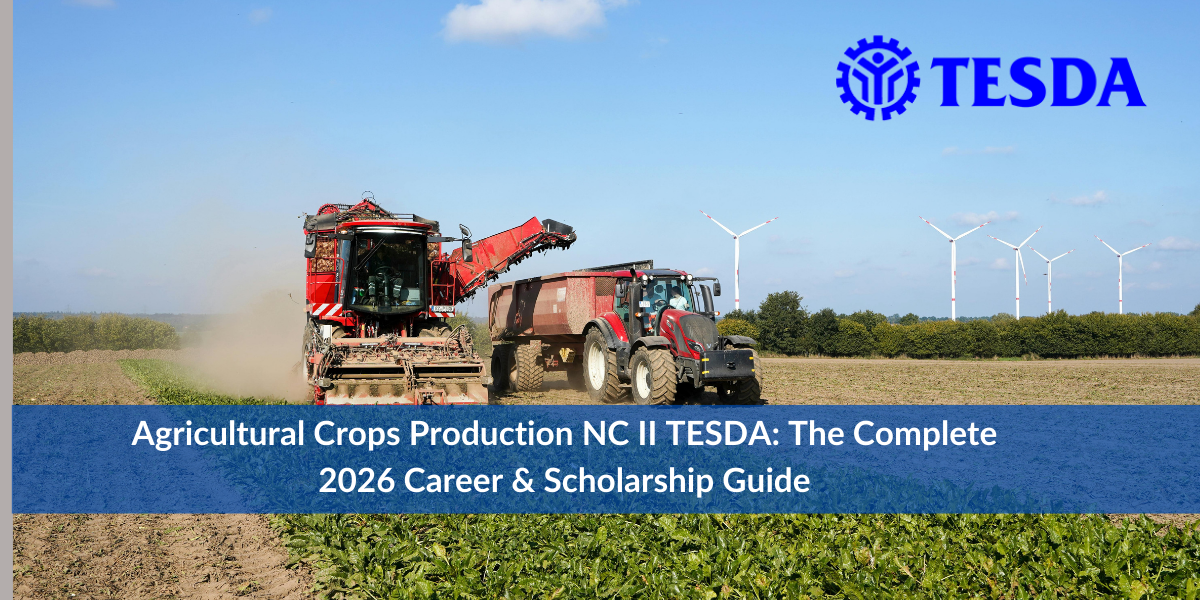
The course featured in your image is part of the TOP initiative. It is 100% free and self-paced. Once you complete the online modules, you can visit a local assessment center for your National Certificate.
2. Chinese Government Scholarship (CGS) 2026
For those wanting to study in Harbin or Beijing, the Northeast Agricultural University is offering fully funded Master’s and PhD programs for NC II graduates.
- Coverage: Tuition, Housing, and a RMB 3,000 monthly stipend.
3. Nuffield Farming Scholarships
The Nuffield Trust is offering $25,000 grants for agricultural researchers to travel the world and study modern crop production.
4. USAID “Feed the Future” Grants
Targeted specifically at young entrepreneurs in South Asia and Africa, these grants provide the startup capital to turn your NC II certificate into a functioning farm.
V. FAQ: Everything You Need to Know
Is Agricultural Crops Production NC II hard?
The “Core Competencies” (260 hours) are intensive, but because the course is hands-on and visual, it has a 98% pass rate for those who follow the modules.
Can I use this certificate to work in Canada?
Yes. Canada’s “Agri-Food Pilot” program often recognizes vocational training like NC II as valid work experience, helping you secure a work permit faster.
Are there any age limits?
No. Whether you are 18 or 60, the agricultural sector values skills over age.
VI. Final Verdict: Should You Enroll?
If you want a career that is recession-proof, high-paying, and globally recognized, the answer is yes. The world will always need to eat, and in 2026, the world is willing to pay a premium for people who know how to grow food efficiently.